
Article by Jon Condon, courtesy of Beef Central
27.01.2026
WITH parts of Australia facing record-high daytime temperatures this week, some beef processors are anticipating disruptions to slaughter cattle supply.
As can be typical in Australia at this time of year, it comes just a week after processors in other parts of the country faced supply challenges due to flooding and impassable roads. Truly a land of droughts and flooding rains.
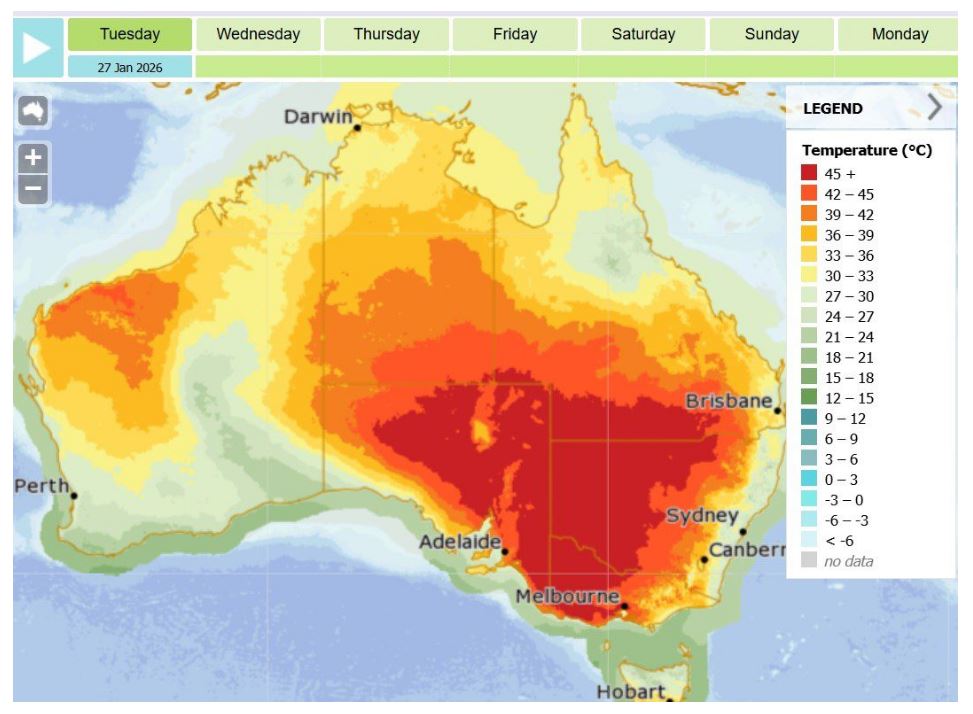
As can be seen in the above BOM image, about 20 percent of the continent is facing extreme daytime temperatures of +45C (+113F), today (dark red in the image), extending into Thursday and Friday in some areas. Several centres are forecast to experience +47C, while an even larger zone (bright orange, signifying 42-45C) extends across much of NSW and Victoria, southern and western regions of Queensland and the eastern half of South Australia.
A number of selling centres have already cancelled cattle and sheep sales this week, due to the weather conditions: They include Warwick sheep (Queensland), Griffith, Deniliquin and Inverell (NSW), Horsham, Shepparton (Vic) and Naracoorte (SA). Others may join the list as the week unfolds.
Tomorrow’s Dalby sale will go ahead, offering only around 4600, but would have offered +6500 if not for the heat limiting factor, one participant said.
A southern processor contact said this week’s heat impact on direct consignment cattle supply was limited, with plenty of advance warning allowing for some preparation – such as scheduling uplifts of stock earlier or later in the day to escape the worst of the temperatures.
Other processors have had to try to fill postponements with more accessible stock or in one case, nearby feedlot cattle.
While cattle movements early this week are somewhat compromised, it’s now clear that cattle are starting to move in numbers across large parts of Eastern Australia.
One processor said his business was prioritising longer and midfed grainfeds in kills for the immediate future, in order to maximise the value on a per tonne basis into the China export market before the country quota is filled some time around April or May.
Direct consignment easing trend
There’s been some downwards movements in direct consignment slaughter cattle offers early this week (however Monday’s holiday has slowed decisions in some businesses).
In Queensland two large export businesses were not offering active quotes this week, claiming to have spaces reasonably well covered through February, or still working through grainfed cattle after the break. One of those is offering space bookings only for the timebeing.
However another large Queensland operator has dropped rates 20c/kg across both grass steers and cows, suggesting it would have happened a week earlier except for the rain/flood/road access disruptions. Best quotes seen this morning in southern Queensland were 810c/kg on four tooth grass ox (820c/kg for HGP-free on some grids) and 730c/kg on good quality heavy cows.
Plants in Central and Northern parts of Queensland are still struggling to raise kills this week due to local logistics problems, with cattle from further away in southern parts of the state continuing to be shipped to fill holes in rosters.
In fact grids in Central Queensland – typically 10-20c behind operators in southern Queensland – are pretty much on par this week due to local challenges caused by road conditions and flooding.
Similarly, its anticipated that the blast of hot weather will push more cattle to market in southern regions over the next few weeks – especially if it delivers no real rain relief.
A southern NSW export plant was this morning offering 820c/kg on no-HGP four tooth grass ox, and 740c/kg on best cows (both back 10c on last week); while operators in eastern parts of South Australia were stronger, showing 840c/kg and 790c/kg on steers and cows, respectively.
Underpinning that is the fact that the national beef herd at 31 million is already close to capacity, meaning any adverse weather conditions and impact on pasture availability is going to be manifested in sell-downs and market impacts quite quickly, one experienced cattle buyer suggested.
“Feedlots are full, plants are already processing at near capacity, so if we get a period of extended dry weather now, it is only going to put stress on the system,” he said.
“The system doesn’t have a lot of slack in it, if the season really starts to turn. The only thing that’s really held it together has been the good summer rain in parts of the north. Without it, it could have been battle-stations by now.”
So far at least, there has been no sign of southern processors heading north into Queensland to purchase slaughter cattle, but locals expect their return by early March – as they did last year for lengthy periods.
Saleyards impacted by weather, market uncertainty
Gunnedah sale this morning yarded 2550, down 1550 on last week due to the hot conditions. It was a pretty good quality yarding with large numbers of well finished cows. Feeder steers sold from 450-494c while the feeder heifers sold from 370-435c/kg. Grown steers and heifers were up to 20c/kg cheaper with quality a factor. Prime grown steers sold from 400-440c while the prime grown heifers sold to 432c/kg. Secondary cows were firm, the prime heavy weights though were 8c/kg cheaper. Score 2 and 3 cows sold from 288- 378c while the prime heavyweights sold from 365c to 393c to average 379c/kg.
Wodonga yarded 1400 this morning, down 900 due to extreme heat. Only a couple of buyers operated in the export run for heavy steers and bullocks. Heavy cattle were reasonable numbers and quality lifted. Demand from domestic and export processors was patchy. Heavy steers and bullocks sold to improved competition with heavy steers selling 14c dearer making from 420-455c/kg. Bullocks were limited and keenly sought lifting 41c making from 420-459c/kg. In the cow sale, heavy cows were well supplied and most buyers operated but were not prepared to push the market. The bulk of the better heavy cows slipping 10c making from 372c to 404c/kg. Leaner cows D3 types under 520kg were mixed selling from 328-368c/kg.
Roma sale was still progressing when this report was filed this afternoon, where 7400 were offered. One participant said the mercury had already hit 38C before the sale started. Early buying was described as ‘selective,’ with prices for heavier cattle under pressure, but smaller cattle solid. Full report tomorrow.
Warwick cattle sale this morning yarded 1650, similar to last week. Bullocks to processors eased by 9-12c/kg with cows remaining firm on last week. Light weight plain conditioned cows to processors made 353c to average 305c/kg. Heavy score 2 cows averaged 351c/kg. Good heavy cows sold to 389c and averaged from 371-384c/kg.
