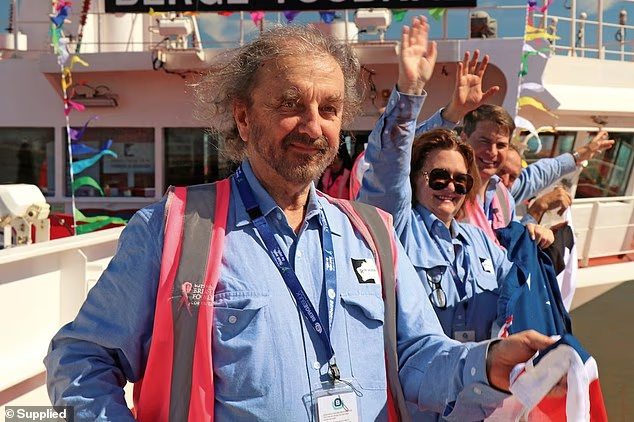
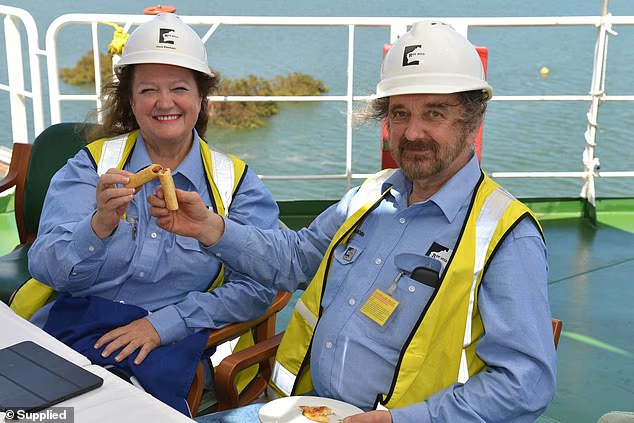
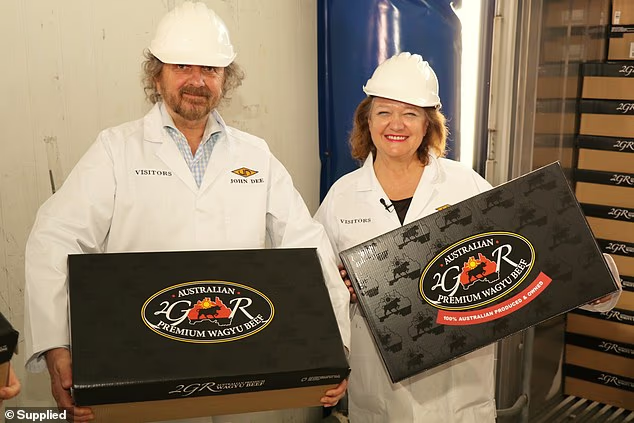
Australia’s richest person Gina Rinehart has paid tribute to the little-known engineer behind her multibillion-dollar mining empire.
As the executive director of Hancock Prospecting, Australia’s largest private company, Tad Watroba has quietly steered some of the nation’s biggest mining projects, alongside Mrs Rinehart, for more than 30 years.
On Wednesday night, the $40billion businesswoman will mark the tenth anniversary of the first ore shipment made from the mine, praising Mr Watroba’s role in getting the $10bn project up and running.
‘Taddie stuck in there with magnificent dedication, loyalty and integrity throughout,’ Mrs Rinehart will say, in a recorded speech to be played at a staff dinner at Roy Hill and extracts of which were obtained by the Daily Mail.
Mrs Rinehart referred to Mr Watroba as a ‘gentleman I have been able to trust for more than three decades, who has worked with me tirelessly day and night’.
‘Together, Taddie and I worked late, gave up weekends, birthdays. We even worked on two Christmas Days.
‘I thank Tad for his magnificent commitment and for helping Hancock and me, and our partners, to realise our vision for the mega mining operation which Roy is.’
Born in Poland, Mr Watroba graduated from Krakow’s AGH University of Science and Technology in 1973, before beginning his mining career in his home country.
He emigrated to Australia in the 1980s, joining Bechtel Asia-Pacific in Melbourne as a senior engineer, before moving into gold mine finance consulting in Perth in 1991.
It was there he answered a Hancock Prospecting job advertisement, initially overseeing the Woodie Woodie mine and pursuing exploration in Thailand.
In an interview with CEO Magazine in 2021, Watroba described himself as ‘the most fortunate mining engineer there is’, having overseen mega projects from exploration to operation.
One of his defining roles came with the Roy Hill iron ore project, Hancock’s $10billion mega-mine and among Australia’s largest, producing 55million tonnes annually.
Mrs Rinehart will mark the tenth anniversary of Roy Hill’s first ore shipment to South Korea on Wednesday, recalling the challenges faced by her relatively small private firm.
‘Advice I received at the time included “The Roy project is far too big for us, we can’t do (it),”’ she said, adding doubts over its viability continued well after they obtained the rights to the mine.
Mr Watroba worked closely with Mrs Rinehart to navigate regulatory hurdles, government approvals, port and rail negotiations, and the completion of a feasibility study.
‘Taddie stuck in there with magnificent dedication, loyalty and integrity throughout. He was an inspiration to others,’ Mrs Rinehart said.