Originally published by Keren Bellos of The Sunday Times.
22 November 2026
Copper, magnesium and steel are hardly the first things that spring to mind when considering the future of cancer care.
Yet, a sophisticated laser-based system being developed to revolutionise medical imaging and deliver more precise cancer treatment relies on all three.
It is just one example of mining’s far-reaching contribution to modern life, with a new report revealing the potential of Western Australia’s resources in fields including healthcare, agriculture, artificial intelligence and defence.
Prepared by EY-Parthenon for the Chamber of Minerals and Energy of Western Australia (CME), the Unearthing Potential: The scale of WA’s resources opportunity report examines 27 commodities and estimates that developing 80 per cent of the state’s identified resources could generate $8.1 trillion in sales revenue.
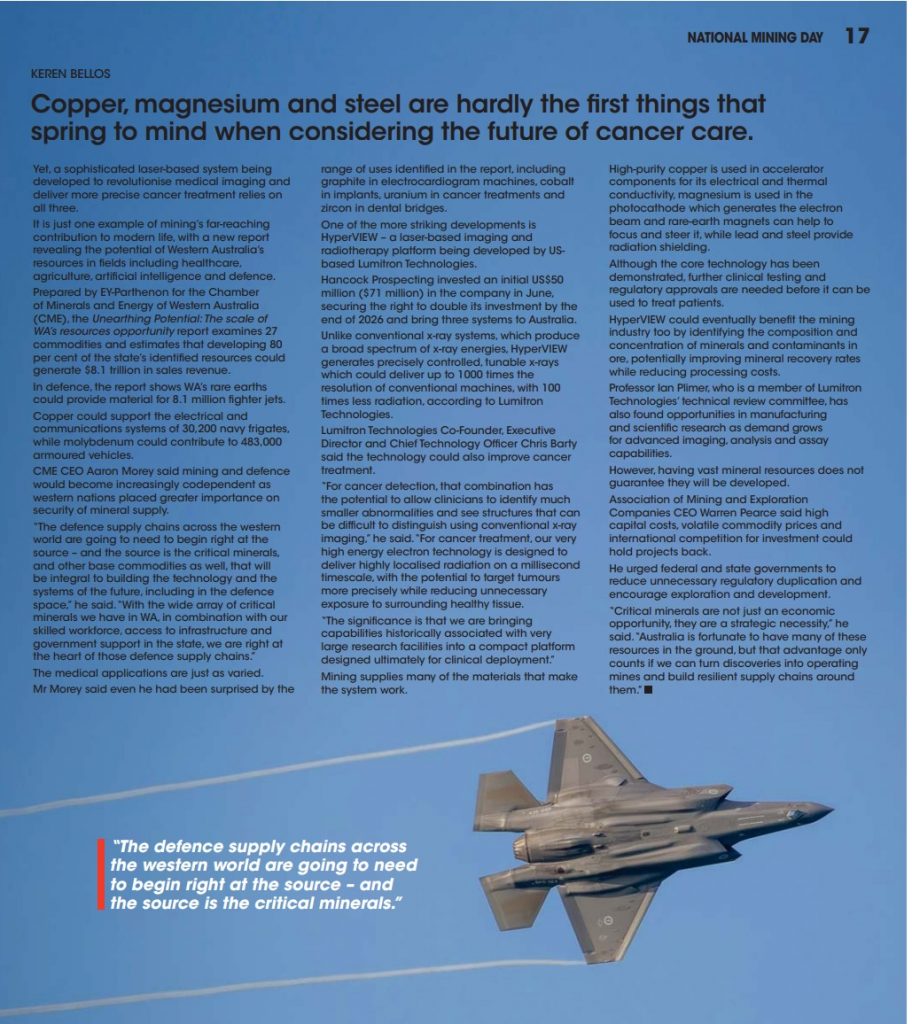
In defence, the report shows WA’s rare earths could provide material for 8.1 million fighter jets.
Copper could support the electrical and communications systems of 30,200 navy frigates, while molybdenum could contribute to 483,000 armoured vehicles.
CME CEO Aaron Morey said mining and defence would become increasingly codependent as western nations placed greater importance on security of mineral supply.
“The defence supply chains across the western world are going to need to begin right at the source – and the source is the critical minerals, and other base commodities as well, that will be integral to building the technology and the systems of the future, including in the defence space,” he said. “With the wide array of critical minerals we have in WA, in combination with our skilled workforce, access to infrastructure and government support in the state, we are right at the heart of those defence supply chains.”
The medical applications are just as varied.
Mr Morey said even he had been surprised by the range of uses identified in the report, including graphite in electrocardiogram machines, cobalt in implants, uranium in cancer treatments and zircon in dental bridges.
One of the more striking developments is HyperVIEW – a laser-based imaging and radiotherapy platform being developed by US-based Lumitron Technologies.
Hancock Prospecting invested an initial US$50 million ($71 million) in the company in June, securing the right to double its investment by the end of 2026 and bring three systems to Australia.
Unlike conventional x-ray systems, which produce a broad spectrum of x-ray energies, HyperVIEW generates precisely controlled, tunable x-rays which could deliver up to 1000 times the resolution of conventional machines, with 100 times less radiation, according to Lumitron Technologies.
Lumitron Technologies Co-Founder, Executive Director and Chief Technology Officer Chris Barty said the technology could also improve cancer treatment.
“For cancer detection, that combination has the potential to allow clinicians to identify much smaller abnormalities and see structures that can be difficult to distinguish using conventional x-ray imaging,” he said. “For cancer treatment, our very high energy electron technology is designed to deliver highly localised radiation on a millisecond timescale, with the potential to target tumours more precisely while reducing unnecessary exposure to surrounding healthy tissue.
“The significance is that we are bringing capabilities historically associated with very large research facilities into a compact platform designed ultimately for clinical deployment.”
Mining supplies many of the materials that make the system work.
High-purity copper is used in accelerator components for its electrical and thermal conductivity, magnesium is used in the photocathode which generates the electron beam and rare-earth magnets can help to focus and steer it, while lead and steel provide radiation shielding.
Although the core technology has been demonstrated, further clinical testing and regulatory approvals are needed before it can be used to treat patients.
HyperVIEW could eventually benefit the mining industry too by identifying the composition and concentration of minerals and contaminants in ore, potentially improving mineral recovery rates while reducing processing costs.
Professor Ian Plimer, who is a member of Lumitron Technologies’ technical review committee, has also found opportunities in manufacturing and scientific research as demand grows for advanced imaging, analysis and assay capabilities.
However, having vast mineral resources does not guarantee they will be developed.
Association of Mining and Exploration Companies CEO Warren Pearce said high capital costs, volatile commodity prices and international competition for investment could hold projects back.
He urged federal and state governments to reduce unnecessary regulatory duplication and encourage exploration and development.
“Critical minerals are not just an economic opportunity, they are a strategic necessity,” he said. “Australia is fortunate to have many of these resources in the ground, but that advantage only counts if we can turn discoveries into operating mines and build resilient supply chains around them.”


Copper, magnesium and steel are hardly the first things that spring to mind when considering the future of cancer care.
Yet, a sophisticated laser-based system being developed to revolutionise medical imaging and deliver more precise cancer treatment relies on all three.
It is just one example of mining’s far-reaching contribution to modern life, with a new report revealing the potential of Western Australia’s resources in fields including healthcare, agriculture, artificial intelligence and defence.
Prepared by EY-Parthenon for the Chamber of Minerals and Energy of Western Australia (CME), the Unearthing Potential: The scale of WA’s resources opportunity report examines 27 commodities and estimates that developing 80 per cent of the state’s identified resources could generate $8.1 trillion in sales revenue.
In defence, the report shows WA’s rare earths could provide material for 8.1 million fighter jets.
Copper could support the electrical and communications systems of 30,200 navy frigates, while molybdenum could contribute to 483,000 armoured vehicles.
CME CEO Aaron Morey said mining and defence would become increasingly codependent as western nations placed greater importance on security of mineral supply.
“The defence supply chains across the western world are going to need to begin right at the source – and the source is the critical minerals, and other base commodities as well, that will be integral to building the technology and the systems of the future, including in the defence space,” he said. “With the wide array of critical minerals we have in WA, in combination with our skilled workforce, access to infrastructure and government support in the state, we are right at the heart of those defence supply chains.”
The medical applications are just as varied.
Mr Morey said even he had been surprised by the range of uses identified in the report, including graphite in electrocardiogram machines, cobalt in implants, uranium in cancer treatments and zircon in dental bridges.
One of the more striking developments is HyperVIEW – a laser-based imaging and radiotherapy platform being developed by US-based Lumitron Technologies.
Hancock Prospecting invested an initial US$50 million ($71 million) in the company in June, securing the right to double its investment by the end of 2026 and bring three systems to Australia.
Unlike conventional x-ray systems, which produce a broad spectrum of x-ray energies, HyperVIEW generates precisely controlled, tunable x-rays which could deliver up to 1000 times the resolution of conventional machines, with 100 times less radiation, according to Lumitron Technologies.
Lumitron Technologies Co-Founder, Executive Director and Chief Technology Officer Chris Barty said the technology could also improve cancer treatment.
“For cancer detection, that combination has the potential to allow clinicians to identify much smaller abnormalities and see structures that can be difficult to distinguish using conventional x-ray imaging,” he said. “For cancer treatment, our very high energy electron technology is designed to deliver highly localised radiation on a millisecond timescale, with the potential to target tumours more precisely while reducing unnecessary exposure to surrounding healthy tissue.
“The significance is that we are bringing capabilities historically associated with very large research facilities into a compact platform designed ultimately for clinical deployment.”
Mining supplies many of the materials that make the system work.
High-purity copper is used in accelerator components for its electrical and thermal conductivity, magnesium is used in the photocathode which generates the electron beam and rare-earth magnets can help to focus and steer it, while lead and steel provide radiation shielding.
Although the core technology has been demonstrated, further clinical testing and regulatory approvals are needed before it can be used to treat patients.
HyperVIEW could eventually benefit the mining industry too by identifying the composition and concentration of minerals and contaminants in ore, potentially improving mineral recovery rates while reducing processing costs.
Professor Ian Plimer, who is a member of Lumitron Technologies’ technical review committee, has also found opportunities in manufacturing and scientific research as demand grows for advanced imaging, analysis and assay capabilities.
However, having vast mineral resources does not guarantee they will be developed.
Association of Mining and Exploration Companies CEO Warren Pearce said high capital costs, volatile commodity prices and international competition for investment could hold projects back.
He urged federal and state governments to reduce unnecessary regulatory duplication and encourage exploration and development.
“Critical minerals are not just an economic opportunity, they are a strategic necessity,” he said. “Australia is fortunate to have many of these resources in the ground, but that advantage only counts if we can turn discoveries into operating mines and build resilient supply chains around them.”